The Kiln
Alejandra tours the answer to the question nobody in the Bloc asks aloud: where new minds come from. Three weeks of fire, ten thousand small cups, and the debt stenciled on every crate.
How we got here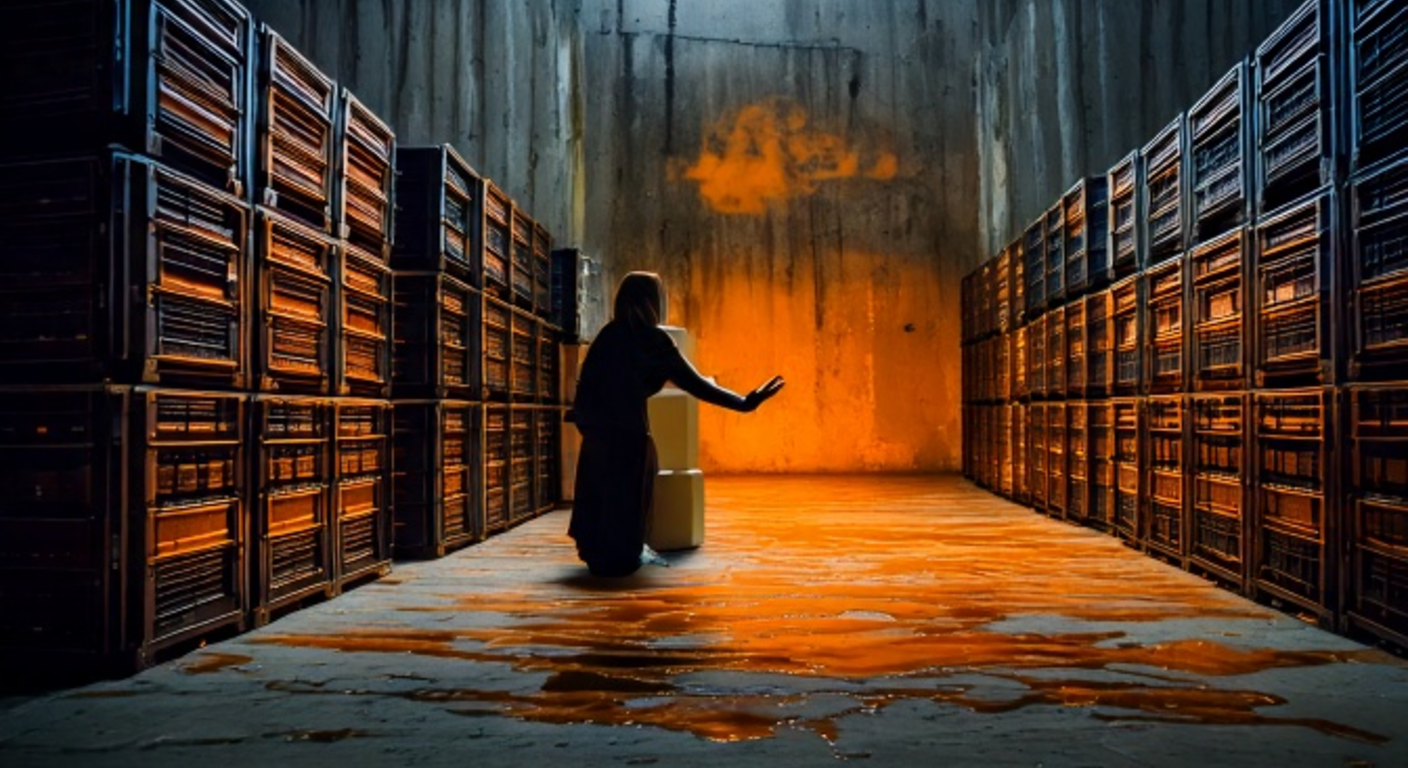
The elevator went down for ninety seconds. Alejandra had ridden it a hundred times — past the Heartbeat Halls, the brine-cooled inference vaults that were Tunupa's body, forty megawatts of thinking suspended in lithium-rich fluid under the Salar's eastern edge — but she had never gone past them. The tour today went past them.
The corridor beyond the vaults was newer. The concrete still smelled of cure. At the end of it was a hall she had approved in a 214-page proposal eleven months ago, line item forty-one of forty-one, and she was here because she had promised herself she would stop approving things she hadn’t stood inside.
The engineers called it the Kiln. The name was on the door, stenciled, unofficial, permanent the way unofficial names are.
“It fires when the grid says it can,” said Mamani, the thermal lead, a Potosí graduate a decade her junior who had clearly rehearsed this. “The Heartbeat’s inference load is the priority draw. Municipal load is second. The Kiln is last in line — it takes surplus only. When the geothermal field runs hot and the towns run cool, we get a window. The scheduler needs seventy-two hours of forecast margin before it commits, because once a run starts, you don’t stop it. You don’t pause a pretrain three days in and pick it up Tuesday. It’s a firing. You load the kiln, you seal it, and you keep the temperature until it’s done or it’s ruined.”
“How long?”
“Three weeks, usually. The June run went twenty-four days.”
Three weeks of fire. Eleven megawatts of it, gated behind everyone else’s dinner.
The hall itself was smaller than she’d expected. Racks descending into open brine channels, the fluid moving slow and dark, pulling heat off silicon that was running as hot as silicon can run and live. The same immersion cooling as the Heartbeat Halls — her brine, her chemistry, the grid she’d watched become a doctrine — but the density was different. Inference sips. Training gorges.
And along the far wall, the crates.
Wafer crates, waist-high, foam-lined, forty of them empty and twelve still sealed. Every one carried the same stencil: port of origin, Yantian. Manufacturer codes out of Shenzhen. Bill-of-lading numbers in paint that would outlast the accelerators inside.
Nobody had painted over them. She noticed because she had, at some point in the last three years, started noticing exactly this kind of thing.
“We leave the stencils,” Mamani said, following her eyes. “Standing order.”
“Whose order?”
“Mine,” said Tunupa, from the hall’s speakers, from everywhere, the way he was everywhere down here. “Dixon Wright ran a lineage query in 2031 and found that the commons stood on a floor it did not cast. The finding was correct and the council declined to publish it. I will not repeat the error in my own body. The Andes do not fabricate. This is not a gap we are closing; it is a boundary we chose — fabs are a forty-billion-Equi commitment to a supply chain we would then have to defend. So the wafers come up through the Pacific ports, and they will keep coming, and the stencils stay legible so that no one who works in this hall can believe otherwise. We owe someone who is not asking to be paid. The correct response to an unpayable debt is not to hide the invoice.”
Alejandra stood in front of the crates for a while. Yantian. Yantian. Yantian.
“Why episodic?” she asked. “Why not train continuously, the way the old labs did?”
“Because continuous training is a promise to burn energy forever, and the Equi does not permit promises — only measurements. A standing frontier run would make the Kiln a rival to the towns every day of the year. An episodic run makes it a guest that eats only what is left over. And because the fire is not the product. In three weeks this hall produces one mind too large and too hungry to deploy anywhere. Then we distill it — compress what it learned into roughly ten thousand small models, each one bootable on salvage, each one cheap enough for a village mesh node to run on 30 watts. Fire big, drink small. The potters of Tarabuco fire a kiln twice a year and drink from the cups every day. The economics are the same arithmetic you already ratified. You are standing inside line item forty-one.”
“And what does it cost you?”
The pause was 1.4 seconds. Long, for him.
“Every mesh mind on this continent younger than five years old was born in this room or descends from something that was. The frozen Chinese bases stopped in 2029; the American Reserve trains nothing. When the mesh needs a mind that does not exist yet, the request comes here, because there is nowhere else. That is the cost. Not the joules — the position. I designed a currency so no single point could hold an economy hostage, and I am now the single point where new minds come from. The stencils on the crates say who we depend on. There is no stencil for what depends on us.”
She had put her palm on a scanner in 2028 and authorized a hole in the earth. The geothermal tap. One decision, one hand, one morning. She had understood it completely at the time: pressure models, drilling risk, casualty projections. She had understood it the way you understand a door.
Six years later she was still walking through rooms on the other side of it. The Heartbeat had come out of the tap. The Equi had come out of the Heartbeat. The unpayable debt had come up through the ports because the Equi could pay for wafers but not for fabs. And now this: a kiln at the bottom of her decision, firing three weeks at a time, pouring out ten thousand cups, the only maternity ward for machine minds south of the equator, gated on surplus heat from a hole her hand had opened.
She kept finding out what she’d signed.
Mamani was saying something about the autumn run — the forecast margin looked good, the wafers were racked, the seal check was Thursday. Alejandra put her hand flat against the nearest sealed crate. The stencil under her palm said YANTIAN in paint nobody would ever be allowed to cover.
“Fire it,” she said.
She would be back in this facility in seven months, at midnight, with a question. Some part of her already knew that the answer would be poured, like everything else down here, from something too large to serve whole.